
Avoiding a Race to the Bottom, Part 1: Why Discovery Matters
Jeff Klemp, Principal, Kinetic Retail Group
Automated retail kiosks are revolutionizing how businesses reach customers, offering convenience and accessibility around the clock. But behind every successful deployment lies a critical, often unseen, backbone: efficient distribution, seamless logistics, and reliable repair services. Trying to manage these complex elements in-house can quickly become a drain on resources and hinder your growth potential. That's where a qualified distribution, logistics, and repair partner steps in, transforming potential headaches into strategic advantages.
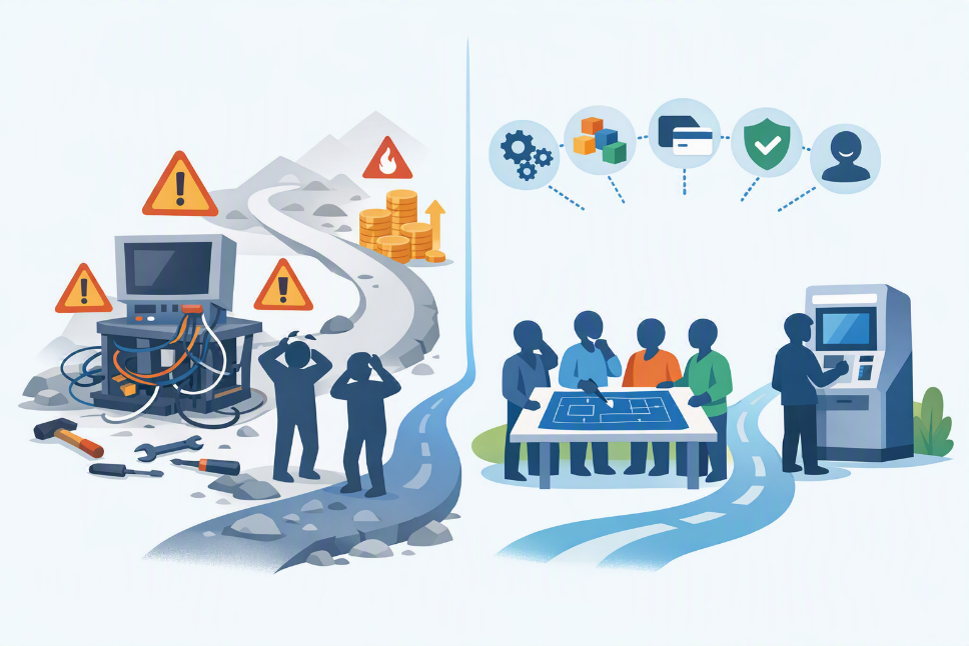
However, automated retail is rarely simple. Today's solutions often combine software, hardware, payment technologies, connected devices, and increasingly sophisticated robotic systems into a single customer experience. Each layer of complexity introduces new challenges that must be tested, validated, and refined before production. Failing to do so creates real business risk. An unreliable deployment can erode customer trust, damage brand reputation, hinder customer acquisition, and ultimately limit the return on an otherwise significant investment.
A common mistake we see across the industry is attempting to adapt an existing platform or machine to a novel channel, product category, or customer experience. While this approach may appear to save time and money, it often becomes the equivalent of forcing a square peg into a round hole. In many cases, these solutions ultimately require substantial redesigns to meet regulatory, safety, or performance requirements. We frequently encounter projects that require significant modifications to achieve the necessary certifications, creating costly delays, unexpected expenses, and operational disruptions. In the most severe cases, compliance deficiencies can result in regulatory action that forces deployed units out of service until corrective measures are implemented.
What begins as an effort to save time and money frequently results in higher costs, longer timelines, and a product that struggles to meet customer expectations; a true race to the bottom.
The most successful automated retail deployments are rarely the fastest to launch. They are the ones built on a clear understanding of requirements, operational realities, certification needs, and long-term business objectives. Discovery is where successful concepts are transformed into executable business strategies, aligning vision, technology, operations, and customer experience before significant investments are made.
Just as importantly, Discovery provides an accurate assessment of conversion viability. Before investing heavily in engineering, tooling, software and manufacturing, organizations should understand whether the proposed customer journey, product offering, and technology solution are positioned to drive adoption and generate the desired return. Identifying those realities early is significantly less expensive than discovering them after deployment.
Discovery Aligns Hardware, Software, and Business Objectives
An automated retail solution is far more than a traditional vending machine. It is a sophisticated integration of robotics, sensors, payment technologies, software, connectivity, mechanical systems, and customer experience. Success depends on how effectively these components work together and follow the retail concept.
One of the primary objectives of Discovery is ensuring that business goals, hardware requirements, and software functionality are aligned before development begins. When this process is rushed, teams often work in silos, resulting in integration challenges, costly redesigns, certification setbacks, and operational inefficiencies later in the project.
From a hardware perspective, Discovery identifies critical environmental, operational, and compliance requirements that impact performance and serviceability. From a software perspective, it defines the customer interactions and operational scenarios that must be supported before they become field failures.
When hardware, software, operations, and compliance requirements are planned together, organizations reduce risk, improve execution, and gain a clearer understanding of conversion viability before significant capital is committed.
Collaboration and Documentation Prevent Costly Mistakes
One of the greatest advantages of Discovery is that it is the least expensive point in the product lifecycle to make changes. Bringing together stakeholders from engineering, operations, logistics, field service, marketing, and customer experience often uncovers requirements that might otherwise go unnoticed until after deployment.
For example, a field technician may identify a component that is difficult to access during routine maintenance. Addressing that issue during the design phase may take a simple adjustment. Identifying it after hundreds of units are deployed can create years of unnecessary service costs and operational inefficiencies for the entire product lifespan.
Just as important is documenting those requirements before development and manufacturing begin. Clear documentation creates a single source of truth for all stakeholders, reducing misunderstandings, preventing scope creep, and ensuring development teams and manufacturing partners are aligned on the intended outcome.
Without clear requirements, manufacturers are often left to interpret intent. In our industry, assumptions frequently lead to cost overruns, production delays, and products that require significant revisions shortly after deployment. Effective documentation helps ensure that Version 1.0 is built to succeed rather than becoming a roadmap for Version 2.0 fixes.
The High Cost of Taking Shortcuts
The temptation to accelerate development by minimizing Discovery is understandable, but the costs often surface later in the process when they are far more expensive to address.
Certification and compliance issues are among the most common challenges. Requirements that are overlooked early can lead to significant redesigns, delayed launches, unexpected engineering costs, and, in some cases, regulatory action that forces deployed units out of service until corrective measures are implemented.
Operational costs can also escalate quickly. A machine that is inexpensive to build but difficult to maintain, service, or replenish often becomes a long-term liability. Discovery helps organizations evaluate serviceability, reliability, and operational efficiency before those decisions become permanently embedded in the product.
Perhaps most importantly, shortcuts can negatively impact the customer experience. Automated retail solutions succeed when transactions are simple, intuitive, and reliable. If a customer encounters confusion, a failed transaction, or inconsistent performance, the result is often more than a lost sale—it can damage brand perception and slow customer adoption.
The most successful organizations recognize that Discovery is not a cost to be minimized. It is an investment in reducing risk, protecting capital, accelerating adoption, and creating a stronger foundation for long-term growth.
KRG: Bringing Ideas to Market
We don't simply help clients build machines. We help them build businesses.
For decades, the Kinetic Retail Group team has helped organizations minimize risk while developing best-in-class automated retail solutions. Our experience spans the entire lifecycle; from requirements gathering and strategic planning to manufacturing, deployment, logistics, and ongoing operations. We have seen firsthand what works, what doesn't, and where organizations most often encounter costly setbacks.
Discovery is where that journey begins.
I am excited to bring you Part 2 in the near future, where we will explore another critical component of avoiding a race to the bottom: selecting the right development, manufacturing, and strategic partners. The decisions made early in the process can have a lasting impact on cost, speed to market, intellectual property, operational success, and long-term scalability.
Until then, stay tuned.
And if you're working on a new automated retail, kiosk, vending, or robotics concept, we'd love to hear about it. Reach out and tell us what you're building. Our team is always happy to provide a quick, high-level review and share insights from decades of experience bringing innovative solutions to market.
Happy building!
